
Key Takeaways
- Definition: Brand governance is the operational system - policies, workflows, tools, and decision rights - that controls how a brand is used across teams, channels, and markets.
- 2026 urgency: AI-generated content, distributed teams, and partner ecosystems have multiplied content volume and inconsistency risk, making governance a core operating discipline.
- Five core components: Interactive brand guidelines, digital asset management (DAM), approval workflows, training, and AI governance.
- Ownership model: A central brand or creative ops team owns the system, supported by a cross-functional governance council across legal, regional marketing, sales enablement, and partner ops.
- Phased implementation: 0–30 days for audit and centralization, 30–60 for standardization, 60–90 for rollout and measurement.
- Success criteria: Adoption rate, approval turnaround time, compliance rate, exception rate, and audit outcomes.
- Tooling stack: Interactive guidelines, DAM, approval workflows, permissions, analytics, and AI content governance - ideally unified in a single workspace.
- Differentiator: Done right, governance increases speed by removing rework and ambiguity, not bureaucracy.
More teams are creating more content across more channels than ever, and generative AI has pushed content volume past what many manual review processes can absorb. Brand governance is the system of policies, workflows, tools, and decision rights that controls how a brand is used across teams, channels, and markets - keeping execution consistent without slowing it down. This guide covers the definition, core components, ownership model, phased implementation, tooling stack, measurement framework, and AI governance needed to keep distributed teams on-brand in 2026.
It is written for brand leaders, brand ops, creative ops, marketing ops, and global or regional marketing leaders who already understand branding fundamentals but need a practical system for ownership, approvals, localization, partner control, and measurable consistency.
What is brand governance?
Brand governance is the system of policies, workflows, tools, and decision rights that controls how a brand is used across teams, channels, and markets. It is an operational control system - not a design discipline, not a static PDF, and not "brand police."
A complete brand governance system includes:
- Standards for visual identity, brand voice, and usage rules
- Approved assets stored in a single source of truth
- Review and approval processes with clear routing and escalation
- Permissions and access controls for internal teams and external partners
- Training for new hires, agencies, and channel partners
- Enforcement and feedback loops that surface exceptions and improve guidelines over time
The distinction matters because static brand guidelines on their own do not change behavior. Governance is what turns guidelines into consistent execution: it determines who can do what, with which assets, under what conditions, and how that work gets reviewed. It connects guidelines, digital asset management, approval workflows, and brand compliance into one coordinated system.
In practice, brand governance answers four operational questions every distributed team faces: Where is the current, approved version? Who decides? How does work get reviewed? What happens when there's an exception?
Why brand governance matters in 2026
The pressure on brand consistency has never been higher. AI-generated content, decentralized content creation, and expanding partner ecosystems mean more people, in more places, are producing more branded content than any central team can review manually. Without a governance system, the result is brand drift - different logos, voices, and claims showing up across markets and channels.
Industry research shows that a majority of organizations still struggle with content consistency across channels, with one widely cited benchmark finding that roughly 6 in 10 teams rate their content as only somewhat or not at all consistent. Knowledge-worker studies referenced in DAM trend reports also estimate that employees spend close to 1.8 hours per day - nearly 20% of the workday - searching for information and assets before they can do real work, according to knowledge workers spending nearly 20% of the workday searching for information.
A brand governance system prevents specific, expensive failure modes:
- Outdated logos and templates in active use - old visual identities resurface in pitches, social posts, and partner campaigns.
- Duplicate asset creation across regions - teams rebuild what already exists because they can't find it.
- Off-brand AI-generated copy and visuals - generative tools produce content that drifts from voice, tone, or visual rules.
- Unapproved partner and agency usage - external collaborators work from stale files or screenshots.
- Brand drift across markets - APAC, EMEA, and HQ teams each interpret the brand differently.
- Approval bottlenecks - review queues get so slow that teams bypass them entirely.
The business impact compounds: wasted production spend, slower campaigns, eroded customer trust, and fragmented experiences, as detailed in studies on the cost of brand inconsistency. These are exactly the brand consistency challenges that governance is designed to solve.
Reframed properly, brand governance is not control for control's sake. It is the system that lets distributed teams move fast safely - by making the on-brand path the easiest path.
The core components of a brand governance system
A brand governance system has five core components. Each one alone is useful; together they form the operating layer that keeps a brand consistent at scale.
Brand guidelines (interactive, not static)
Brand guidelines define logos, typography, color, voice, imagery, and usage rules. In 2026, static PDFs are often not sufficient because they go out of date the moment they are downloaded and they cannot be searched in the moment of need. Interactive guidelines - hosted, versioned, linked to live assets, and embedded with examples - can improve adoption because they update centrally and are accessible at the point of work. A modern branding guideline portal sits alongside assets, not in a separate folder.
Digital asset management (DAM) and centralized assets
A DAM is the source of truth for approved, current files. It enforces governance through metadata, taxonomy, naming conventions, and access permissions, drawing on DAM taxonomy and metadata best practices, and modern platforms often add AI-powered search so people can find the right asset faster. Without a DAM, governance collapses because there is no agreed-upon "current" version. Building brand identity through digital asset management is what makes consistency operational.
Approval workflows
Approval workflows route work to the right reviewers based on content type, channel, audience, and risk. Strong workflows are tiered - low-risk requests use pre-approved templates and self-serve, while higher-risk work routes to brand, legal, or compliance. Automation removes the manual coordination that creates bottlenecks. This is where creative operations for brand management becomes the connective tissue between guidelines and execution.
Training and education
Training closes the gap between rules and behavior. It needs to cover onboarding for new hires, agencies, and partners - and then continue as ongoing reinforcement, not a one-time session. The most effective training is embedded directly inside the workflow: tooltips in guideline pages, examples next to templates, and brand champions in each region or function who can answer questions locally.
AI governance for branded content
AI governance is a first-class component in 2026, not an afterthought. It covers policies for AI-generated copy, visuals, and localization; prompt governance and approved inputs; human-in-the-loop review thresholds for higher-risk outputs; and brand voice safeguards for generative tools. Without AI governance, generative content can become a major source of brand drift, which is why frameworks like the AI content governance principles from NIST AI Risk Management Framework are increasingly adopted by enterprise brand and legal teams.
Who owns brand governance? Building the operating model
Central ownership is the model that works, a pattern reinforced by Forrester research on marketing operations maturity. A brand, marketing, or creative ops team owns the governance system itself - the policies, the workflows, the tooling, and the standards. But governance is cross-functional in execution: legal weighs in on regulated claims, regional marketing adapts for local relevance, sales enablement controls customer-facing templates, and partner ops manages external access.
The most resilient operating model layers three things on top of central ownership: a cross-functional governance council that meets regularly to review exceptions and update standards, functional owners for specific domains (DAM admin, workflow design, training, AI policy), and a clear regional exception process so local needs don't become workarounds. Teams formalizing these responsibilities often use a RACI framework for cross-functional decision rights to remove ambiguity. For broader context on the strategic layer above governance, see what is brand management.
Roles and decision rights
Governance fails most often not from weak policies but from undefined ownership. When everyone is responsible, no one is - and exceptions become precedents.
Step-by-step brand governance implementation framework
A workable rollout fits in a 90-day window. The goal is not to perfect every policy on day one but to move from fragmented assets and ambiguous decisions to a working baseline that can be measured and improved.
Phase 1 (0–30 days): Audit, align, and centralize
The first 30 days are about getting honest visibility into the current state.
- Run a brand audit across markets, channels, and partner-facing assets. Sample live content (web, email, social, sales decks, partner sites) and score it against current guidelines.
- Identify decision-makers and stakeholders across brand, creative, legal, regional marketing, sales enablement, and partner ops.
- Inventory existing assets and flag outdated, duplicate, and unauthorized files.
- Consolidate into a single source of truth - move approved assets into one workspace and deprecate the rest.
Most initial audits surface the same patterns: outdated logos and templates still circulating, duplicate assets across drives and inboxes, inconsistent colors and messaging by region, fuzzy approval paths, and partners working from old screenshots instead of the latest guidelines.
Phase 2 (30–60 days): Standardize and systematize
With visibility established, the next 30 days are about building the system.
- Publish or refresh interactive brand guidelines with live examples and linked assets.
- Define approval workflows by content type, channel, and risk level. Tier them so low-risk requests don't pay a high-review tax.
- Set permissions, access roles, and partner share rules. Decide what is downloadable, what is view-only, and what expires.
- Document the AI usage policy - approved tools, approved inputs, mandatory human review thresholds, and brand voice guardrails.
- Train an initial cohort of users, including brand champions in each function or region.
Phase 3 (60–90 days): Roll out, train, and measure
The final phase is about adoption and measurement.
- Phased rollout by team or region, not a big-bang launch.
- Continuous training and a brand champion network to handle local questions and feed issues back to the central team.
- Set baseline metrics - adoption, approval SLA, compliance rate, exception rate - and start tracking them weekly or monthly.
- Open the feedback loop. Exceptions, search queries, and approval comments become inputs for the next guideline update.
This is also where maintaining brand consistency across platforms shifts from intent to measurable practice.
Governance maturity stages
- Foundational: Guidelines plus a shared drive. Works for small teams but breaks at scale.
- Scaling: DAM, interactive guidelines, approval workflows, and permissions in place. Adoption tracked.
- Enterprise: Integrated tech stack, AI governance, measurable scorecard, partner governance, and continuous feedback loops feeding guideline updates.
Brand governance tools and software in 2026
Governance is a stack, not a single product. The strongest 2026 setups consolidate as much of that stack as possible into one workspace - because every additional tool boundary is a new place for brand drift, version confusion, and access errors to creep in. Below is a practical evaluation framework, followed by the categories of brand management software that matter and how they compare.
Evaluation criteria
1. BrandLife - All-in-one brand governance platform
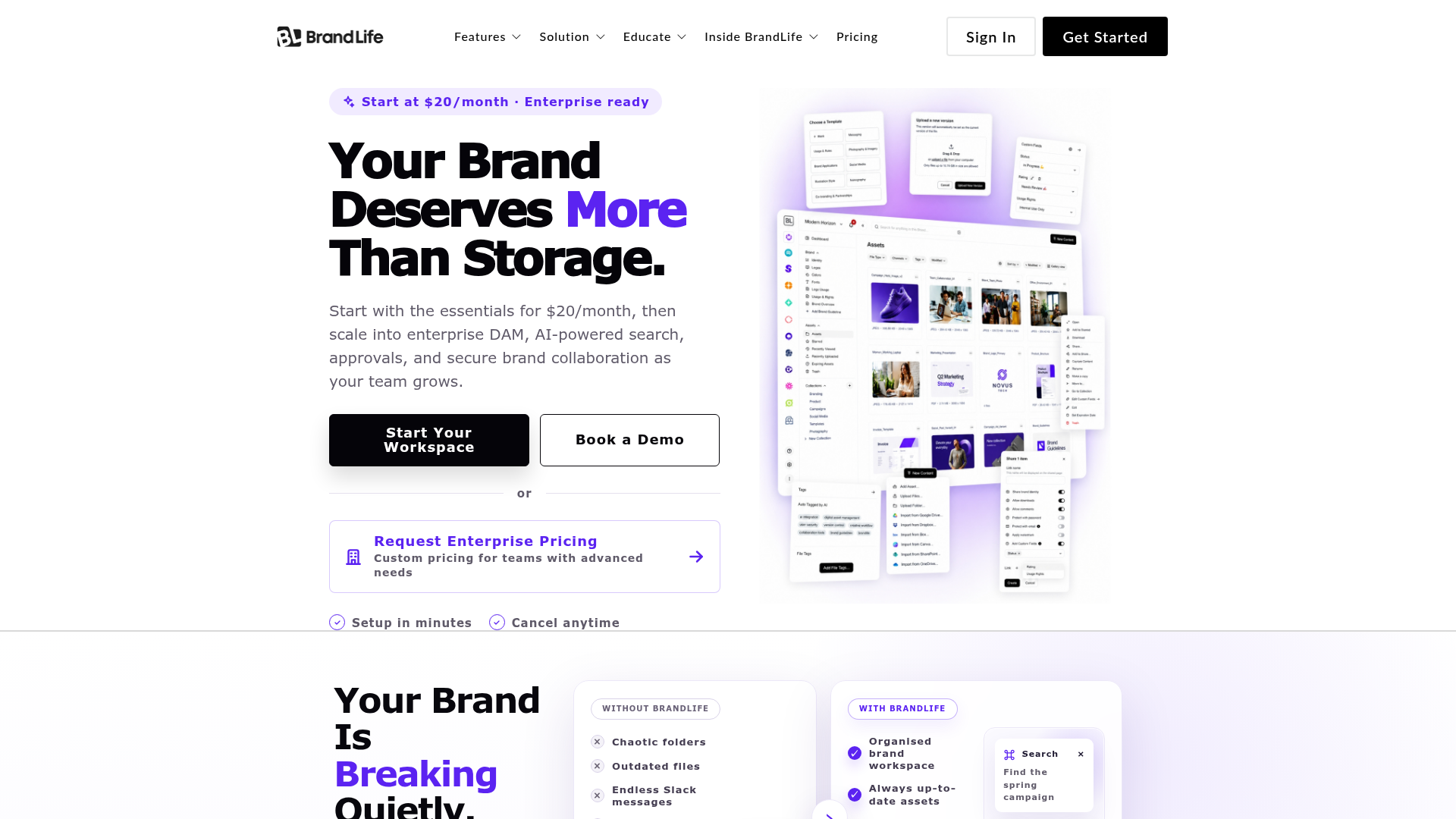
BrandLife brings interactive brand guidelines, centralized asset management, approval workflows, AI-powered search, version control, and secure external sharing into a single governance workspace. That consolidation is the point: it removes the seams between "where the rules live," "where the files live," and "how work gets approved," which is exactly where most governance systems break.
Mapped to the evaluation criteria:
- Asset centralization: One workspace for assets, templates, and guidelines, reducing reliance on parallel drives.
- Interactive guidelines: Live, versioned guidelines linked directly to the approved assets they describe.
- AI-powered search: Helps reduce one of the most common causes of brand drift - teams using whatever they can find instead of what's current.
- Version control: Current vs. deprecated states, audit trail, and rollback so the latest approved asset is clear.
- Approval workflows: Routing for review and publishing, with permissions that match the way real teams operate.
- Permissions and secure sharing: Scoped access for agencies, partners, and sales reps so the right people see the right assets without exposing the full library.
- Cross-team usability: Team collaboration designed for brand, creative, sales, and partner teams in one place.
- Pricing model: Starts at $20/month, with a flexible usage-based model that scales as teams add users, storage, and brands.
Watch a Product Demo to see how the workspace handles guidelines, search, version control, approvals, and secure sharing end to end.
2. Digital asset management (DAM) platforms
Standalone DAM platforms centralize files, apply metadata, and control permissions. They are strong on storage, taxonomy, and version control but often require separate tooling for interactive guidelines and approvals - which can reintroduce the seams governance is meant to remove. Examples in this category include Bynder, MediaValet, Brandfolder, Canto, Acquia DAM, and Aprimo.
3. Brand guidelines platforms
Brand guidelines platforms focus on hosting interactive style guides - logos, color, typography, voice, examples. They are a major upgrade over PDFs, but when separated from asset management, teams still have to jump between the guideline and the actual file, which is where drift creeps in.
4. Approval workflow and creative ops tools
Workflow and review tools handle routing, comments, and approvals. They work well when integrated with the DAM and guidelines layer; as standalone systems, they tend to create another silo and another login. Tier approvals by risk so they accelerate work rather than queue it.
5. AI content governance tools
An emerging 2026 category. These tools apply brand voice guardrails to generative AI outputs, flag off-brand language, and enforce approved prompts and inputs. As AI-generated content volume grows, this layer becomes essential to maintain brand consistency across machine-assisted production.
Brand governance guardrails - balancing control and speed
Guardrails are not gates. They are the conditions that let people move quickly inside approved boundaries. The mental model shift is critical: governance is not about reviewing more work, it is about designing the system so the right path is also the easiest path. The principles below are what ensuring brand consistency looks like in practice.
- Principle 1: Tier approvals by risk. Low-risk work (social posts using approved templates) should be self-serve. High-risk work (regulated claims, identity changes) gets full review. Treating everything the same forces teams to bypass review entirely.
- Principle 2: Centralize what protects the brand, decentralize what unlocks speed. Identity, voice, and high-visibility templates stay centrally owned. Local adaptation, channel-specific copy, and campaign variations decentralize to the teams closest to the work.
- Principle 3: Build templates for the 80% of repeat needs. Off-brand work often happens when no template exists for a recurring task, so people improvise. Templates are governance.
- Principle 4: Make the right path the easiest path. Findability is a control mechanism - when approved assets are easier to find than outdated ones, compliance happens on its own.
- Principle 5: Permit exceptions, but track them. Exception rate is a governance metric. Patterns in exceptions reveal where guidelines, workflows, or templates need updating.
Pro tip: Governance fails when approved assets are harder to find than outdated ones. Findability is not a DAM feature - it is a governance control.
Governing external partners, agencies, and sales teams
Brand drift often happens at handoffs. Agencies, distributors, franchisees, sales reps, and co-marketing partners are all working with brand assets every day, often without the same training or tools as the internal team. Effective global brand management requires explicit governance for each external stakeholder type, and Deloitte research on global brand localization highlights why regional adaptation needs explicit guardrails rather than ad-hoc workarounds.
- Agencies: Scoped access to current-only assets, routed approvals back into the internal workflow, and time-limited shares for projects.
- Sales teams: Pre-approved templates with locked brand elements and editable variables only - name, region, product line - so reps can personalize without breaking the brand.
- Channel partners and franchisees: Localized portal access with regional adaptation rights inside defined guardrails, plus expiring or watermarked downloads for sensitive assets.
- Co-marketing partners: Dedicated brand kits with usage rules, approved logos, and a clear request path for anything outside the kit.
Pro tip: Brand drift often happens after assets leave HQ. Secure sharing with scoped permissions, expiration controls, and approved download paths protects the brand at its riskiest point.
How to audit and measure brand governance success
Governance you can't measure is governance you can't improve. The goal is a scorecard that mixes leading indicators (adoption, approval speed) with lagging indicators (compliance rate, duplicate assets) so you can act before audits surface problems.
Governance scorecard
How to run a brand governance audit
A governance audit is a repeatable check, not a one-time event.
- Sample assets across channels, teams, and regions - web, email, social, sales decks, partner pages.
- Score against current guidelines for logo usage, color, typography, voice, and claim accuracy.
- Identify root causes for each off-brand instance: findability, training, workflow, or policy gap.
- Close the loop by updating guidelines, retiring outdated assets, retraining users, and adjusting workflows.
Many organizations set internal targets around 90–95% of audited assets being fully on-brand once the system has been in place for multiple quarters, with quarterly audits and DAM analytics tracking the trend over time. The trajectory matters more than any single score - improving compliance quarter over quarter is the real signal that governance is working.
Common brand governance failure points (and how to avoid them)
Most governance programs fail for the same handful of reasons. None of them are about strategy - they are about execution.
- Static PDFs instead of living guidelines. Move to interactive, embedded guidance linked to the assets it describes.
- No clear ownership. Define a governance council, name functional owners, and document decision rights.
- Too many approval layers. Tier reviews by risk and remove approvers who don't add unique value.
- Poor findability. Invest in AI-powered search, strong metadata, and consistent naming so the right asset is always easier to find than the wrong one.
- No version control. Mark current versions, deprecate old ones, log every change, and make rollback possible.
- Training as a one-time event. Build continuous reinforcement, in-workflow guidance, and a brand champion network so knowledge stays current.
Pro tip: Track exceptions instead of trying to eliminate them. Exception patterns reveal exactly where guidelines, templates, or workflows need to improve.
Brand governance vs. brand management vs. brand compliance
These terms get used interchangeably, but they describe different disciplines with different owners and outputs. Understanding the distinction sharpens decisions about staffing, tooling, and metrics. For the strategic layer above governance, see strategic brand management.
In short: brand management drives the brand forward, governance keeps execution aligned, compliance verifies adherence, and enablement accelerates the people doing the work.
The future of brand governance: AI, automation, and continuous feedback
Brand governance is shifting from a periodic discipline to a continuous one. The drivers are AI content volume, real-time analytics, and unified workspaces that collapse fragmented tooling. The teams building a strong brand management strategy for 2026 are designing for all three.
AI-generated content governance
Generative AI is now embedded in everyday marketing work, with a majority of teams experimenting with or regularly using AI tools in some part of their content workflow, according to research on generative AI adoption in marketing teams. That means governance frameworks for approved prompts, approved input data, brand voice safeguards, and mandatory human review thresholds are no longer optional - they are part of the core operating model.
Continuous feedback loops
Exception data, search queries, and approval comments are governance inputs. Mature programs feed these signals back into guideline updates and workflow tweaks every quarter, treating governance as a learning system rather than a fixed rulebook, an approach echoed in the Content Marketing Institute benchmark on content consistency.
Usage insights and predictive governance
Analytics that flag at-risk assets before they go live - stale templates, unauthorized variants, voice drift in AI drafts - move governance from reactive to predictive. Usage data also drives smarter guideline refreshes by surfacing what teams actually need, supported by human-in-the-loop review standards for generative AI that keep brand reviewers in the loop on higher-risk outputs.
Unified governance workspaces
A clear 2026 trend is the move away from fragmented stacks (separate guideline tool, separate DAM, separate workflow tool, separate AI policy) toward unified workspaces that combine all four for brand, creative, sales, and partner teams. Fewer seams means fewer places for governance to break.
Getting started with brand governance at your organization
You do not need to build the full enterprise system on day one. A minimum viable governance program covers the essentials and creates a baseline to improve.
Minimum viable governance checklist:
- Audit current assets and live content across channels and regions
- Define ownership and tier approvals by risk
- Centralize approved assets and guidelines into one workspace
- Publish interactive guidelines linked to live assets
- Set baseline metrics for adoption, approval SLA, and compliance
See how BrandLife brings interactive guidelines, AI-powered search, version control, approvals, and secure sharing into one governance workspace - starting at $20/month and scaling with your team. Watch the Product Demo.