

Key Takeaways
- A brand guide is the documented set of rules for how your brand looks and sounds across every channel and partner.
- Modern brand guides work as living, searchable systems tied to your assets. Static PDFs go stale fast.
- The building blocks are brand foundations, visual identity, verbal identity, digital and e-commerce standards, plus governance.
- Build one in seven steps, namely, audit, align on core, design and document, co-create with stakeholders, choose a format, launch and train, then maintain.
- Grab the free template below and keep every section in one place.
- BrandLife hosts your brand guide next to your assets and AI search, so teams actually use it.
Building a brand guide means documenting how your brand looks, sounds, and behaves, then giving your team and partners one place to check that instead of guessing. Lucidpress, now Marq, surveyed hundreds of brand management professionals and found that consistent brand presentation was associated with revenue increases of up to 33%. That distance is where most brand teams live, in the slow accumulation of a slightly wrong logo here and an outdated tagline there.
Your creative lead just reworked a partner deck for the third time this week, after the logo and tone drifted across two markets without anyone deciding to change either one. The rules that were supposed to prevent that sat in a PDF buried in a shared drive, which nobody thought to check before the deck went out.
Brand teams often manage multiple brands and outside partners at once, and a static file in a shared drive struggles to keep up. Franchisees and agencies pull assets on their own schedule, and small inconsistencies pile into real brand drift.
This guide covers what a brand guide is in 2026 and why it matters right now, with the core building blocks and a seven-step process to build one, plus a free template and real-world patterns to round it out.
What a Brand Guide Does for Your Team
A brand guide is the official rulebook for how your brand appears and sounds, sometimes called a brand style guide or brand guidelines, and it sets the standards that keep your work recognizable across teams and partners:
The old model was a PDF deck that a designer emailed once and updated rarely, looking polished on page one before drifting out of date fast. Partners downloaded whatever version they had saved, which made the current version hard to verify. A franchise network with 30 locations, for example, can easily end up with 30 different PDF versions in circulation, each one slightly out of date in a different way.
Designers talk about this constantly in their own communities. A thread on Figma's community forum, titled "7 Ways To Reinvent Your Brand Guidelines Template," makes the point directly, arguing that static PDFs are outdated and that teams should move to interactive, cloud-based guides instead. It's advice aimed at freelancers and agencies, but it applies just as directly to an in-house brand team watching its own guidelines go stale in a shared drive.
A modern brand guide works differently:
BrandLife customers report 40% less time searching for assets and 50% faster launch cycles, along with 70% fewer asset-request emails and 6+ hours saved weekly per creative, once rules and assets live together.
How to Build a Brand Guide Step by Step
Building a brand guide takes seven steps, moving from a messy asset audit to a live guide your team can maintain, with each step ending in a concrete deliverable.
Step 1: Audit and research
Start by inventorying what you already have, from old decks to live social posts. Flag inconsistencies as you go. Note every logo variant and off-spec color you find. Capture what each stakeholder team needs from the guide.
Deliverable: a brand reality report that shows where current usage pulls apart.
Step 2: Align on brand core
Aligning on your brand core means running short workshops to lock your positioning and audience segments, then deciding how each core idea shows up in visuals and voice. A premium positioning might mean a restrained palette and quieter photography, while a playful one may lean brighter and rounder.
Deliverable: a finished brand foundations section ready to drop into the guide.
Step 3: Design and document the systems
Work with design and copy to formalize the visual and verbal rules. Set your logo system and palette. Then lock type and imagery direction. Write your voice and copy rules alongside them. Build correct and incorrect usage examples for the elements people misuse most. Fold in digital and accessibility requirements here.
Deliverable: A draft brand guide, either a document or a platform prototype.
4. Co-create with stakeholders
Share the draft with brand leadership and the regional and e-commerce managers who apply it daily. Bring in partner managers too. Ask where the language confuses them and where edge cases slip through. Simplify wording and add real examples where questions pile up.
Deliverable: A refined guide validated by the people who use it.
5. Choose the right format and platform
Choosing the right format means matching the guide's home to how people will use it:
We recommend the third model, because the rules and files stay in the same place.
Deliverable: a live brand guide interface your whole organization can reach.
6. Launch, educate, and enforce
Adoption starts with a coordinated rollout. Announce the guide across internal channels and your partner network in the same week. Run training for internal teams, then separate sessions for agencies and franchisees. Set up clear help paths like "Request an exception" and "Ask brand" so people escalate instead of guessing.
Deliverable: An adoption plan with training and ongoing support.
7. Maintain and improve
Scheduled upkeep keeps the guide useful. Review it quarterly or twice a year, and tie extra reviews to campaigns or rebrands. Use feedback from live work and customer research to sharpen the rules. Keep a changelog with version history so anyone can see what changed and when.
Deliverable: A governed brand guide that stays useful instead of aging into a forgotten file.
The Building Blocks of a Modern Brand Guide
A modern brand guide has five connected building blocks that turn scattered rules into a working system, starting with the brand core and closing with the governance that keeps everything current.
1. Brand foundations
Brand foundations answer who you are before anyone touches a logo file, capturing your mission, vision, values, personality, positioning, audience, and market context. Add a "brand in one page" summary for execs and new hires who want the short version, then link those foundations to real output. Show how a value like sustainability shapes your photography choices or your social copy. Abstract statements stick when readers see them applied.
2. Visual identity
Visual identity documents everything your brand looks like, and it deserves the tightest documentation since brand drift usually starts here:
WCAG contrast guidance gives you defensible accessibility thresholds to build against.
3. Verbal identity
Verbal identity documents how your brand sounds, carrying the brand as much as visuals do:
4. Digital and e-commerce standards
Digital and e-commerce standards cover the rules that a print deck never has to think about. Cover web and UI microcopy, button and form conventions, and social platform dos and don'ts for the channels your team uses. For commerce, set product title formats and image standards by channel, since a marketplace listing and your own store need different specs, and include accessibility rules for alt text and caption formatting.
5. Governance and operations
Governance names who owns the guide and how it stays enforced. Name who owns the guide and who can approve changes, and document approval workflows and the escalation path for exceptions. Set a review cadence and an onboarding process for new hires and partners. This is the bridge into brand ops and your DAM, where access control, version history, and audit trails support the rules in daily work.
Brand Guide Examples and Inspiration
Some of the best-known consumer brands treat their guidelines as living, public systems rather than a PDF locked in a drive, and three in particular show what that looks like in practice.
Mailchimp built its brand guidelines as an interactive site, and Mailchimp Art Director Jane Song has described the philosophy behind that choice directly: "Think of your brand style guide as a living document." The guide pairs hand-drawn illustrations and a conversational tone with concrete rules for logo use, color, and voice, so a freelancer or partner can see the reasoning behind a rule.

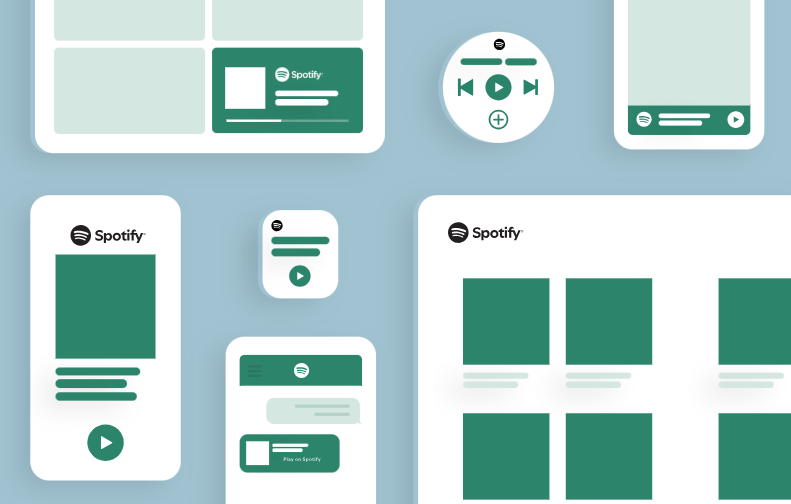
Spotify takes a similar approach with its own design and branding guidelines, covering logo use, artwork handling, and platform-specific rules in one connected system rather than a static deck. Spotify's guidelines were originally developed with the agency Collins and also document co-branding rules for partners, spelling out exactly how the logo and colors should behave when they appear along with another company's branding, which is the same problem a multi-brand agency runs into internally.
Your Free Brand Guide Template
The free template gives you seven ready-to-fill sections, each mapped to a building block from the steps above, so you can drop in your own rules and color codes and move the whole file into a place your team checks daily.
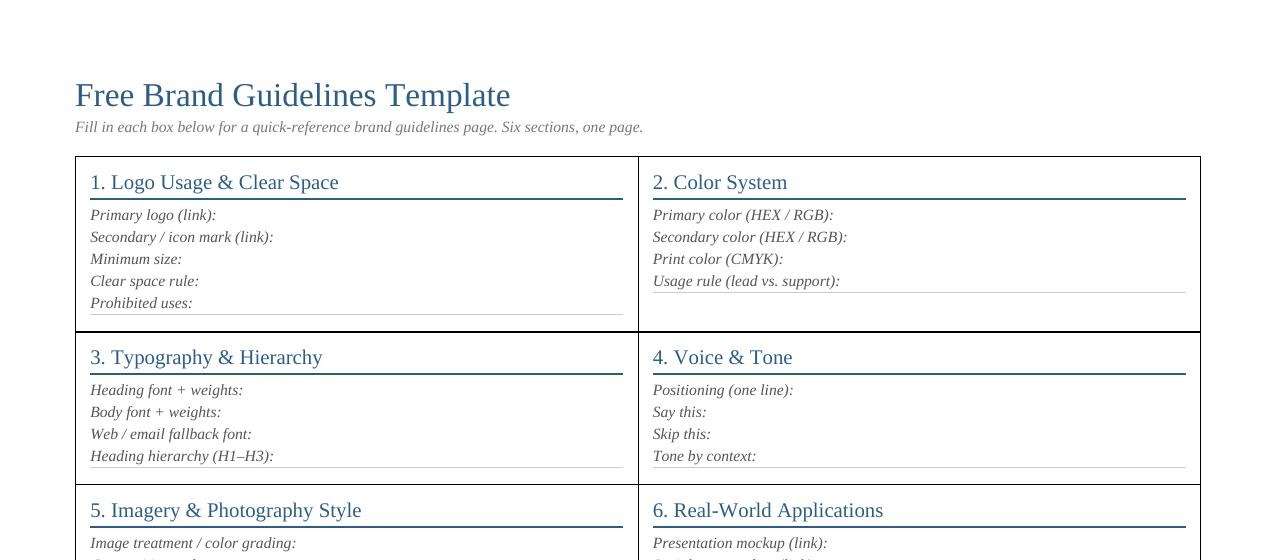
Brand foundations open the first page with fields for mission, vision, values, personality, positioning, and audience context. From there, the template covers:
A filled template on a desktop helps one person, and value shows up only when your whole team can reach it in the middle of a project. Move it somewhere central, link each section to the assets it describes, assign an owner for every section, and set a review date on the calendar. Host it where your team already works, next to the files they pull. That single move turns a static document into a guide people follow.
How BrandLife Turns Your Brand Guide Into a Living Workspace
A strong brand guide works best as a living system your team can update over time, covering your brand foundations, visual identity, and verbal identity, then backing those up with digital and e-commerce standards and clear governance. The build process is simple: audit what you have, align on the brand core, document the rules, involve the people who use them, choose a practical home, train teams, and keep the guide current.
BrandLife customers claim 6+ hours saved weekly per creative when rules live where the work happens. BrandLife hosts your interactive brand guidelines next to the asset library, so visual and verbal rules live in one workspace, and the guide updates in place instead of aging into a stale PDF. When the guide sits next to your assets, your team spends less time on revisions and moves faster, and BrandLife customers claim 50% faster launch cycles in that setup.
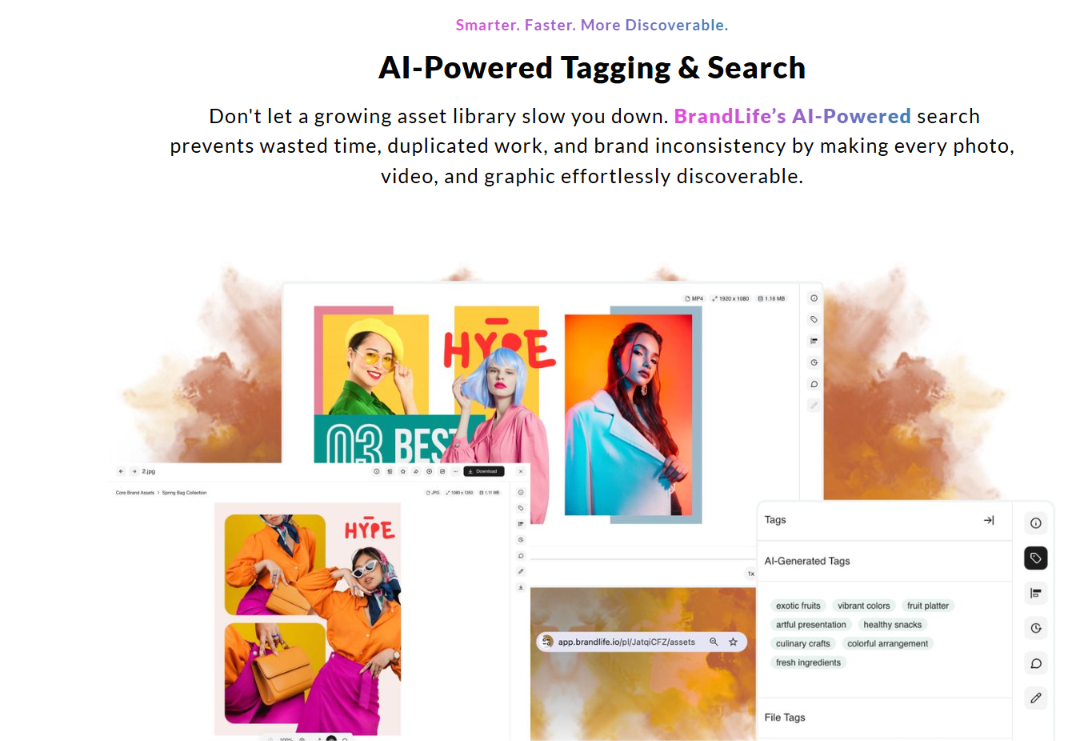
The platform fits multi-brand reality. Each client can run in its own multi-brand workspace, and the same setup works for a brand or sub-brand, with every workspace getting separate palettes, font libraries, and storage. AI-powered search and tagging help teams find the right file fast, approval workflows support brand-safe reviews, and partner portals give franchisees and agencies a self-serve view of approved assets, with secure sharing and link controls.
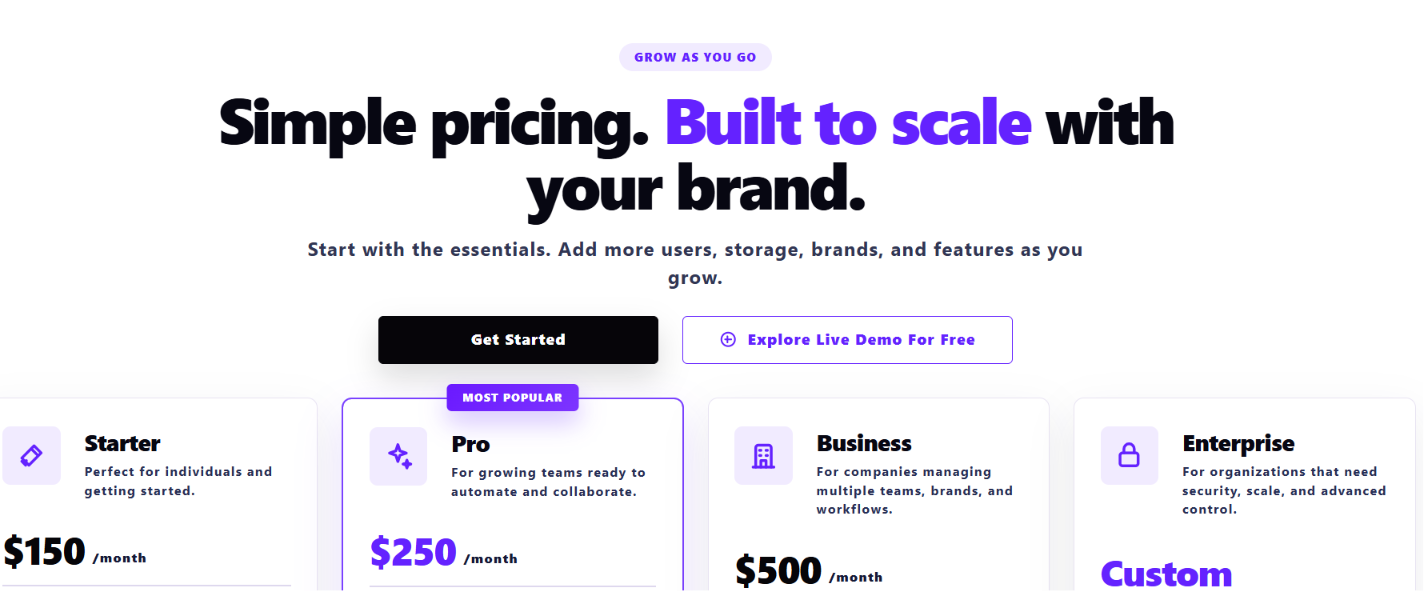
Pricing stays transparent. Starter runs $150/month for 1 user, 1 brand, and 1GB of storage, and Enterprise is custom, with unlimited users and unlimited brands. Review the full breakdown on the pricing page.
If you want your guide to live where the work happens, BrandLife is built for that. Get started today.
Frequently Asked Questions
1. How long should a brand guide be?
Length follows brand complexity. A small team can cover the essentials in a lightweight guide. A multi-brand organization usually needs modular, searchable sections instead of one long document. Findability beats page count every time.
2. What's the difference between a brand guide, brand book, and brand kit?
The three terms overlap, so quick definitions help. A brand guide is the full rulebook for how you look and sound. A brand book leans toward story and philosophy, covering your mission and values. A brand kit is the practical asset bundle, with logo files and color codes ready for your design tools.
3. Who should own the brand guide?
Ownership usually sits with a Head of Brand or Marketing Ops lead. That person keeps the guide current and approves changes. In a multi-brand setup, a central owner can manage shared standards while local owners handle market-specific rules.
4. How often should you update a brand guide?
Review it quarterly, or twice a year at minimum. Tie extra reviews to real triggers like a campaign launch or a rebrand. Keep a changelog with version history so anyone can see what changed and when.
5. Do small teams and startups really need a brand guide?
Yes. Starting early helps teams prevent drift before it hardens into habit. A lightweight guide can scale as you add channels, partners, and new hires.